

Concrete, fiberglass and vinyl: how pools are built
Florida pool designs start with construction. There are three types of pools by construction method, and the type decides what the design can be.
Custom luxury work is concrete for a simple reason: it is the only construction type designed for the specific site. Sun shelves, raised spas, vanishing edges, perimeter overflow, grottos, glass tile spillways and integrated benches all begin as reinforced concrete, engineered for the soil and groundwater on that lot. Where a high water table is anticipated, the Florida Building Code requires an approved hydrostatic relief device in the pool (R4501.21.4), one of many details that make a concrete pool a piece of site engineering rather than a product. Lombardo Pools builds its custom pools in concrete; see how that work is sequenced in new pool construction.
- Concrete (shotcrete or gunite): a steel-reinforced shell sprayed in place, then finished with plaster, quartz, pebble or tile. According to the American Shotcrete Association, shotcrete is the umbrella term for sprayed concrete; gunite refers only to the dry-mix process, in which water is added at the nozzle, while wet-mix shotcrete is pumped already mixed. Any shape, depth or built-in feature is possible.
- Fiberglass: a factory-molded, one-piece shell set into an excavation. Installation is quick and the gelcoat surface is smooth, but the shape and size are limited to the manufacturer's molds and to what can be trucked to the site.
- Vinyl liner: a vinyl membrane over a wall-and-floor structure. It is the least expensive to build, the liner is replaced periodically, and the shapes are limited.
Geometric and modern swimming pool designs
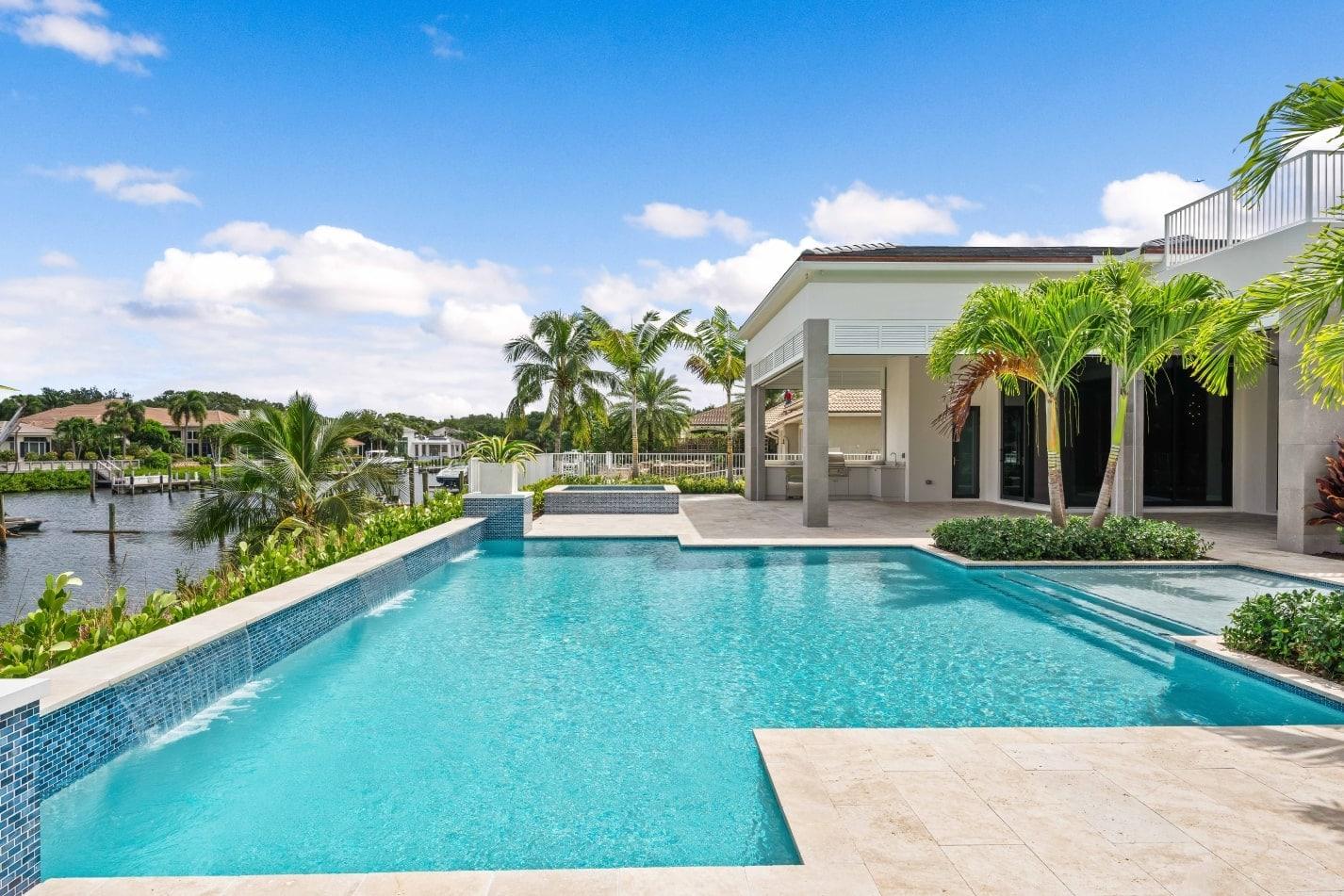
Geometric pools are rectangles, squares, L-shapes and their combinations, with lines that align with the house. They suit modern, contemporary and formal Mediterranean architecture, where the pool reads as an extension of the floor plan and the view from inside is as important as the view from the deck.
The detailing carries a geometric design: a slim coping or a flush deck, a glass tile waterline, a raised spa set on axis with a doorway, a sheer descent or scuppers along a back wall, fire bowls at the corners, and a sun shelf at the shallow end. Each of those elements is planned into the shell from the start. See water and fire features and custom spas for how they are built.
Freeform, lagoon and grotto pools
Freeform pools trade straight lines for curves and suit Old Florida, Caribbean and tropical gardens, where planting comes right up to the water. A lagoon pool takes the idea further with boulder edges, beach-like shallows and naturalistic planting. A grotto adds a rock cave or overhang, usually with a waterfall across the opening, and becomes the focal point of the garden.
These are among the most demanding pools to build well. The rockwork has to be structurally sound, watertight, safe to sit on and convincing at arm's length, and the boulders and planting should look as if the water arrived later. That depends on the landscape as much as the pool, which is why our sister company, Lombardo Landscaping, joins the design when a client wants both. Learn more about natural pools and grottos.
Vanishing edge, perimeter overflow and spillway pools
A vanishing edge pool, also called an infinity or negative edge pool, lets water flow over one or more edges into a catch basin below, so the surface appears to meet the view beyond. It needs a real view and a change in level, which on a flat lot usually means raising the pool and facing it toward open water, a lake or a golf course. A perimeter overflow pool brings the water to the brim on every side, spilling into a concealed channel at deck level; it is the most architectural of pool types and suits modern houses with a flush, uninterrupted deck.
Both depend on a surge tank or basin, careful hydraulics and precise level work, and both cost more to build than a conventional skimmer pool. Where the site or budget does not call for a full vanishing edge, a spillover spa or a glass tile spillway brings some of the same sound and movement at a smaller scale.
Lap pools, plunge pools and spools
A lap pool is long and narrow, sized for swimming rather than lounging, and fits side yards and long, slim building envelopes. Inside a screened lanai it gives year-round exercise a few steps from the house. A plunge pool is small and deep enough to cool off in, often paired with a spa or set in a courtyard.
A spool, a small pool built with spa jets and a heater, works as a spa in the cooler months and a plunge pool in summer, and it suits courtyards, compact lots and secondary terraces. For a swimmer with limited space, a swim jet in a compact pool is an alternative to a full-length lap lane.
Sun shelves, beach entries and the features that shape a pool
Some of the most-used parts of a Florida pool have little to do with swimming. A sun shelf, or tanning ledge, is a broad shallow platform for in-water loungers and umbrellas. A beach entry slopes gradually from the deck into the water, the way you walk into the Gulf. Benches, swim-outs, wide entry steps and raised spas define how people actually use the pool.
Several of these also satisfy code. The Florida Building Code requires steps or a ladder in the shallow end of any pool where the water is deeper than 24 inches, and ladders, stairs or underwater benches and swim-outs in the deep end where it exceeds 5 feet (R4501.18). Designing those elements as seating and entries, rather than adding a ladder at the end, is part of what separates a custom pool from a standard one.
Screened or open-air pools in Florida
In Southwest Florida, one early decision is whether to screen the pool. A screen enclosure, or pool cage, keeps out leaves, insects and much of the debris, and when it meets the barrier rules it can serve as the pool's required safety barrier, where the code treats it as a nondwelling wall (R4501.17.1.11). It is a structure in its own right: the Florida Building Code sets wind design pressures for screened enclosures by wind speed and exposure (Section 2002.4). The trade-offs are a framed view and a structure that must be maintained.
Open-air pools suit view lots on the Gulf, the bays and the lakes, and architecture that a cage would interrupt. They need a different barrier strategy, such as a compliant fence or wall, alarms or self-latching hardware on the doors that open to the pool, or a certified pool alarm, and they take more cleaning. A third option is a screened lanai off the house with an open pool terrace beyond. See pool cages and screen enclosures and the barrier rules in our Florida pool regulations guide.
Let the architecture of the house choose the pool
The house is the surest guide to the right type of pool. A modern house with flat roofs and large glass openings asks for a geometric pool, a slim or flush coping and a restrained palette. A Mediterranean or Spanish-revival house suits a formal rectangle or a classical shape, with travertine, a raised spillover spa and loggias framing the water. An Old Florida or Caribbean house wants curves, planting and natural stone. A coastal house built up above the flood level may set the pool on a raised terrace or at grade below the main floor, and the stairs, retaining walls and sightlines between them become part of the design.
On waterfront lots, sun, view and breeze often matter more than shape. Our custom pool design process works this out in 3D before construction, so you can see the pool from the kitchen, the dock and the upper floor before anything is built. The pool deck materials guide covers the surfaces that frame each style.