

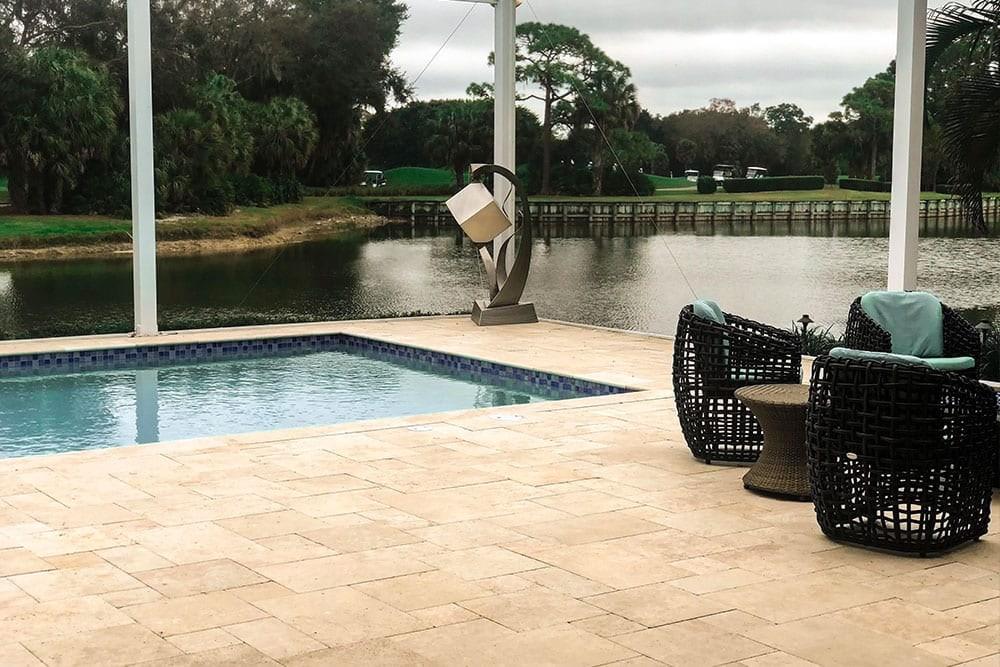
What is pool decking?
Pool decking is the walkable surface around a pool: the coping that caps the pool edge, the deck that surrounds it, and often the terraces, steps and paths that tie it to the house and garden. Choosing among pool deck materials in Florida is a bigger decision than in most places. The deck is walked on barefoot for much of the year, it is wet several times a day, it sits in strong sun, and near the coast it takes salt from the air and, with a salt chlorine generator, from the pool itself.
The deck also does technical work. It sheds rain toward drains or lawn, it sits over the pool's electrical bonding, and in some jurisdictions it counts toward the lot's impervious area (see Florida pool regulations). The right material is chosen with the pool, not after it.
Pool decking options at a glance
How the main swimming pool deck materials behave in Southwest Florida conditions, in general terms. Individual products vary widely, so ask for technical data and stand on a wet sample before deciding.
- Travertine: comfortable underfoot in light tones, good grip when tumbled or brushed; porous, so it needs sealing.
- Marble: dense and refined, bright in white tones; slippery if polished and etched by acids, so use honed, brushed or tumbled finishes outdoors.
- Shellstone: fossil-rich limestone with a soft coastal texture; grips well and stays comfortable in light tones; sealing recommended.
- Limestone: ranges from soft to very dense; the dense, light varieties make quiet, contemporary decks.
- Porcelain pavers: very low water absorption, fired-in color, no sealing; grip depends on the surface texture and the manufacturer's slip classification.
- Concrete pavers: durable and repairable one unit at a time; darker colors run hot and surface color can wear.
- Clay brick pavers: color that runs through the unit, good grip, traditional character; warmer underfoot than light stone.
- Poured and stamped concrete: a continuous surface that follows any curve; needs careful joints, and glossy sealers make it slick.
- Cool-deck coatings: light, textured coatings over concrete that feel cooler than bare concrete; recoated over time.
- Wood and composite: warm and architectural; real wood needs ongoing care in Florida humidity, and many composites get hot in direct sun.
Natural stone pool decks: travertine, marble and limestone
Travertine is a limestone deposited by mineral-rich spring water, and its natural pores are part of its character. For a pool deck it is usually supplied as pavers in a tumbled or brushed finish, which gives the surface grip, with matching coping pieces that wrap the pool edge. Ivory, cream and walnut tones stay comfortable in full sun, which is why travertine is such a familiar sight around Florida pools. The trade-off is upkeep: unsealed travertine absorbs stains, and its pores can hold salt if the pool runs a salt system or the house sits on the water.
Marble is limestone or dolomite recrystallized under heat and pressure, which makes it denser and more uniform than travertine. White marble pavers read crisp and modern against blue water and reflect a great deal of sun. Outdoors, specify a honed, brushed or tumbled finish rather than polished, and keep acids away from it: marble, travertine and limestone are all calcium carbonate stones and will etch, so pool chemicals should be handled away from the deck.
Limestone as a category runs from soft, chalky stones to dense, fine-grained ones. The denser, lighter limestones make calm, contemporary decks in large formats. Ask the supplier for the stone's water absorption and its guidance for exterior and pool use, and keep the softer end of the range away from the waterline.
Shell stone pool decks: shellstone, coquina and keystone
Shellstone is a fossil-bearing limestone in which shell and coral fragments stay visible on the surface. The trade name is used loosely and the quarry of origin varies from product to product, so ask where a given stone comes from and request a sample from the actual lot you will receive. In light tones it is comfortable to walk on in full sun, its open texture grips well when wet, and like other porous limestones it benefits from a quality penetrating sealer.
Florida has its own shell and coral stones, and they explain the look. Coquina is a rock of shell fragments bound together by calcium carbonate; the Spanish quarried it on Anastasia Island to build the Castillo de San Marcos in St. Augustine. Keystone is a decorative stone cut from Key Largo Limestone, a fossil coral reef, and the quarry at Windley Key in the upper Keys produced it until the 1960s. Today's shellstone pavers carry the same fossil character into a uniform, cut paver suited to a pool deck.
Shellstone suits coastal, Mediterranean and transitional houses, and it pairs naturally with landscapes of palms, sea grape and native planting. It is a strong choice on the islands and along the Gulf, where the material looks like it belongs to the place.
Porcelain pavers, concrete pavers and brick
Porcelain pavers are thick, dense, fired ceramic slabs made for exterior use, laid over a compacted base, on pedestals or set in mortar. Porcelain is defined by very low water absorption, so it does not take stains or salt into its body, its color is fired in, and it needs no sealing. Many are made to resemble stone or wood. Grip is the variable to check: under ANSI A326.3, manufacturers can declare a product use classification, and the Exterior, Wet category is the one intended for level outdoor areas such as pool decks. Ask for it on the product data sheet. Dark porcelain gets hot.
Concrete pavers are manufactured units laid on a compacted base with sand joints. They are durable, they move with the ground rather than cracking as a slab would, and a damaged paver can be lifted and replaced. Color sits in the concrete and at the surface, and darker colors run noticeably hotter. How they are laid can also matter for permits: Collier County's stormwater guide counts pavers on a limerock base as impervious area and pavers without a limerock base as pervious.
Clay brick pavers are fired clay, so their color runs through the unit and holds over time. A herringbone or basketweave pattern suits Old Florida, Key West and other traditional architecture, and the textured face grips well. Brick is darker than most stone, so it runs warmer underfoot, and in deep shade any masonry deck that stays damp can grow algae.
Poured concrete, stamped concrete, cool deck and wood
Poured concrete gives a continuous surface that can follow any curve, which is why it is still found around many freeform pools. A broom or light texture keeps it from being slick. Stamped concrete presses a stone or tile pattern into the wet slab; it can look convincing at a distance, but a glossy sealer makes it slippery and the color layer can wear in traffic. All concrete cracks, so the joint layout matters as much as the finish.
Cool-deck coatings are light, textured coatings applied over a concrete deck, sold under several brand names. Their color and texture keep them cooler underfoot than bare concrete, and they can refresh an older deck without demolition, which suits them to pool renovations. They need recoating over time, and Collier County counts cool deck as impervious area.
A hardwood deck brings a warm, architectural edge to a modern pool or a raised spa, especially where the deck steps down to water or a dock. Dense tropical hardwoods are the usual choice (ipe is one example). In Florida sun and humidity, real wood needs regular cleaning and oiling or it weathers to silver, and every fastener and framing member near the water must suit the exposure. Composite and PVC boards remove most of that upkeep, but many get hot in direct sun, so test a sample in the afternoon. Wood works best as an accent, such as a spa platform or a dock transition, with stone or porcelain at the coping.
Heat, grip and salt: choosing pool deck materials for Florida
Heat underfoot is driven mostly by color. Light, reflective surfaces absorb less of the sun's energy, the same principle the U.S. EPA describes for cool pavements, so ivory travertine, white marble, light shellstone and light porcelain stay more comfortable than charcoal pavers or dark composite. A dark stone will feel hotter than a light coating, whatever the material's reputation.
Grip comes from texture. Tumbled, brushed, sandblasted and flamed finishes grip; polished stone and glossy-sealed surfaces do not. For porcelain and tile, ANSI A326.3 gives a measurable basis, so ask for the declared classification rather than relying on a showroom description.
Salt is the quiet test. When salt water dries inside a porous stone, crystals form in the pores and over time can pit or flake the surface. Dense materials such as porcelain resist it. Travertine, limestone and shellstone hold up with a quality penetrating sealer renewed on the supplier's schedule, rinsing after heavy splash-out, and balanced pool chemistry. At the waterline, where splash-out is constant, use the densest coping you are happy with.
Maintenance follows from the three: natural stone asks for periodic sealing and cleaning, porcelain asks for cleaning, concrete asks for crack repair and recoating, and wood asks for the most.
What we recommend for Southwest Florida pool decks
For most Southwest Florida homes, a light natural stone in a textured finish is the strongest all-round answer: tumbled or brushed ivory travertine or a light shellstone for Mediterranean, coastal and transitional architecture, and honed or brushed white marble or a dense light limestone for modern houses. Each stays comfortable in sun and grips when wet. Each also needs sealing, which is the honest cost of natural stone.
Porcelain is the right call where low maintenance matters more than natural texture, where the deck takes heavy salt exposure, or where the design calls for a precise, uniform field. Brick and concrete pavers suit traditional houses, garden paths and drives. Poured concrete and cool-deck coatings make sense on renovations and secondary areas of a larger site. Wood is an accent.
Before deciding, stand barefoot on wet samples in the afternoon sun. The material, the coping profile and the drainage should be set together during design; see how we approach pool deck installation, or request a consultation to look at materials for your house.
Sources
- U.S. National Park Service, Coquina: The Rock that Saved St. Augustine
- Florida State Parks, Windley Key Fossil Reef Geological State Park
- Florida Geological Survey, Key Largo Limestone
- Why Tile (Tile Council of North America author), ANSI A326.3 product use classifications
- U.S. EPA, Using Cool Pavements to Reduce Heat Islands
- Collier County Growth Management, Stormwater Plan Guide (10/15/2025)
- Collier County Growth Management, Application Requirements: Pools (PRSPL, 1/27/2025)