

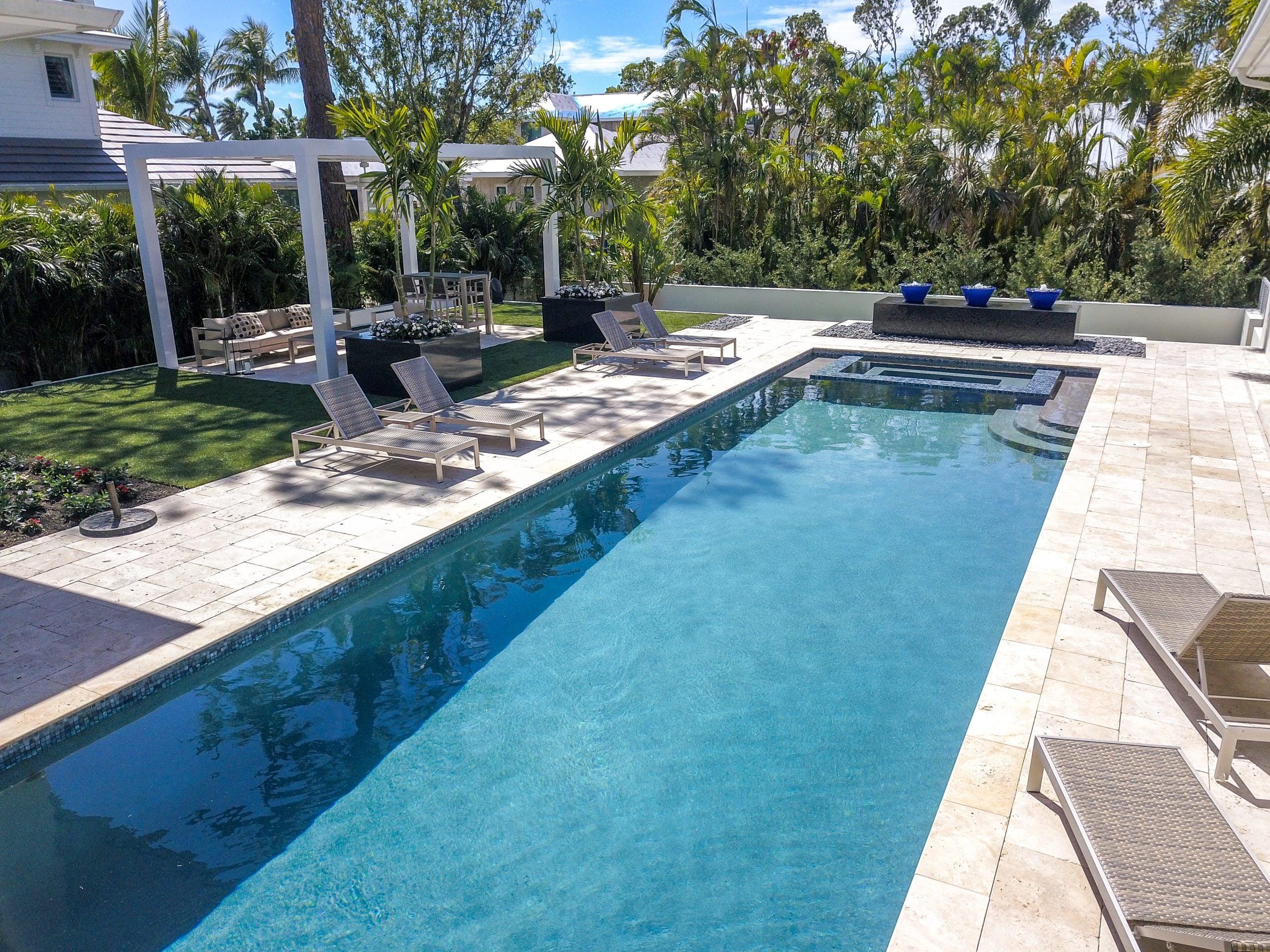
How much does a pool cost in Florida? The published averages
How much a pool costs in Florida has two answers: the published average, and the price of the pool you actually want. National and Florida cost guides give a useful floor. According to HomeGuide's Florida pool cost guide (August 2025), an inground pool in Florida typically costs $35,000 to $120,000, and a concrete pool $50,000 to $120,000. HomeGuide's national inground pool guide (July 2025) puts the average range at $25,000 to $100,000, or $80 to $250 per square foot installed, and describes the average inground pool as about 300 to 400 square feet.
Those figures describe a typical backyard pool: a few hundred square feet of water, a standard interior finish and a modest deck. Luxury custom work sits well above them, and it should be priced differently. Residential Lombardo Pools projects range from $150,000 to $2,000,000, because the scope often reaches beyond the water to the spa, the features, the deck, the enclosure and the landscape around it. Commercial pools and water features are budgeted separately, and those projects can exceed $2,000,000.
Inground pool cost in Naples and Fort Myers
There is no reliable published average for Naples or Fort Myers alone, and an average would say little about a custom pool on a canal, a golf course lot or a Gulf-front parcel. What moves the cost of a pool in coastal Southwest Florida is mostly the site and the level of finish: waterfront lots with seawalls, coastal flood zones that call for engineered pool design, community architectural review, limited access on established streets and the islands, and stone, tile and features chosen to match the house.
Two pools of the same size can land far apart once those factors are counted. The honest way to price a pool in Naples, Fort Myers, Bonita Springs, Cape Coral or on Sanibel and Marco Island is to price the specific design for the specific lot. Our Naples and Fort Myers pages look at what building a pool in each place involves.
What drives a custom pool budget: the pool itself
These are the design decisions that move a custom pool budget most, roughly in the order they come up in design.
- Size and depth. Surface area and volume drive excavation, steel, shotcrete, interior finish, equipment sizing and water. Deep ends add more than their area suggests.
- Shape complexity. Curves, multiple levels, raised walls, sun shelves, benches and swim-outs all add formwork, steel and finishing labor.
- Interior finish. Plaster, quartz, pebble and full glass tile interiors differ widely in cost and in how long they last.
- Tile and coping. Waterline tile, glass mosaic, stone coping and custom edge profiles are priced by the linear foot and by the skill they take to set.
- Deck area and material. Square footage and the choice among travertine, marble, shellstone, porcelain and pavers both matter; see pool deck materials compared.
- Spa. A raised spillover spa, a flush spa or a separate hot tub each brings its own shell, jets, heating and controls.
- Water features. Sheer descents, scuppers, bubblers, rock waterfalls and grottos add structure, plumbing and often dedicated pumps.
- Fire features. Fire bowls and fire tables need gas or propane lines, ignition and controls.
- Vanishing edge or perimeter overflow. Catch basins, surge tanks and exacting level work put these among the most expensive pool types to build.
- Automation and lighting. Smart controls, variable-speed pumps, automated valves and LED lighting zones.
- Heating. Heat pumps, gas heaters or both, sized for the pool, the spa and how warm you want the water in January.
What drives a custom pool budget: the site
In Southwest Florida the lot often matters as much as the design. These conditions are found during site review and engineering, and they belong in the budget from the start.
- Screen enclosure. A cage is its own engineered, permitted structure; Lee County's pool application, for example, notes the enclosure is permitted separately. Height, span, roof profile and screen type drive its cost.
- Site access. Narrow side yards, mature landscaping, existing hardscape and island locations limit equipment and slow excavation and deliveries.
- Soil and water table. Poor soils can call for engineered foundations, and a high water table means managing groundwater during construction and installing the hydrostatic relief device the Florida Building Code requires where a high water table is anticipated.
- Seawalls and waterfront. A pool near a seawall must not load or undermine it, which can mean added structural engineering, deeper foundations or work on the seawall itself.
- Coastal flood zones. In coastal high-hazard (V) zones the Florida Building Code requires pools to be designed and constructed to ASCE 24 (R322.3.3.1). Pool equipment in a flood zone may sit below the required flood level only if it is raised as far as practical, anchored against flood forces and fed by GFCI-protected circuits, as Cape Coral's 2026 permit notice quotes the code. Gulf-front lots seaward of the Coastal Construction Control Line generally need a state permit as well.
- Permits and engineering. Surveys, structural engineering, hydraulic calculations and permit fees are fixed costs of building properly; our Florida pool regulations guide explains what is reviewed.
- Landscape integration. Planting, landscape lighting, drainage, retaining walls and outdoor kitchens are where many pool projects become complete outdoor environments. Lombardo Pools works with its sister company, Lombardo Landscaping, when a client wants both.
From wish list to budget: design consultation and 3D design
A custom pool budget starts as a wish list: the swim, the spa, the sun shelf, the fire, the view from the kitchen. The design consultation turns that list into a plan. Detailed planning starts with the site, meaning the survey, the flood zone, the setbacks and any community architectural rules, and with how you intend to use the space through the year.
The design is then developed in 3D, the core of our custom pool design work, so you can see the pool, deck, spa and features in place, from the rooms you will see them from, before construction begins. That is where the budget becomes real. Every element is visible, so every element can be priced, kept, changed or phased: a full glass tile interior can become a glass tile waterline, a vanishing edge can become a spillway, an outdoor kitchen can move to a second phase. You see what each choice does to the design before committing to it.
The result is a budget built from the actual design, not a per-square-foot guess. Read how the steps fit together in our pool design and construction process, or request a consultation to begin with your own lot.
Ongoing costs to plan for
The build is not the only number. A pool has running costs for energy, chemicals or salt cells, cleaning and equipment service, and a concrete pool's interior finish is eventually renewed; HomeGuide's national guide estimates resurfacing every 10 to 15 years. Heating choices, pump efficiency and automation all affect what the pool costs to run each month. Careful start-up and steady chemistry from the first fill keep those costs predictable.
Sources
- HomeGuide, How much does it cost to build a pool in Florida? (August 14, 2025)
- HomeGuide, How much does an inground pool cost? (July 16, 2025)
- 2023 Florida Building Code, Residential, 8th Edition, Chapter 3 (R322.3.3.1 pools in coastal high-hazard areas)
- 2023 Florida Building Code, Residential, 8th Edition, Chapter 45 (R4501.21.4 hydrostatic relief)
- City of Cape Coral, Notice to Industry: Final Survey Requirement for Pool/Spa and Generator Permits (amended February 2026)
- Lee County Pool Permit Application (10/2025)
- Florida Statutes, Section 161.053, Coastal construction and excavation