

Florida swimming pool laws at a glance
Pool regulations in Florida come in layers that all apply at once. The state sets the safety minimum, the Florida Building Code sets the construction rules, and your city or county issues the permit and applies its own zoning code, which is where setbacks and lot coverage are decided. Federal law covers drain covers, and a pool shared by five or more units falls under the Department of Health.
This guide summarizes each layer as it stands in November 2026, with every number taken from the statute or code text listed in the references. It is general information, not legal or engineering advice. The building official who reviews your permit has the final word, and local ordinances can add to anything written here.
- State law: Chapter 515, Florida Statutes, the Residential Swimming Pool Safety Act (safety features and barriers).
- Building code: Florida Building Code, Residential, Chapter 45 (construction, equipment, barriers, final inspection).
- Local government: the city or county building department (permits, inspections) and its land development code (setbacks, coverage, stormwater).
- Shared and public pools: Chapter 514, Florida Statutes, and Chapter 64E-9, Florida Administrative Code (Department of Health).
- Federal law: the Virginia Graeme Baker Pool and Spa Safety Act (drain covers).
The Residential Swimming Pool Safety Act (Chapter 515)
Chapter 515 covers pools at a detached one- or two-family home or a one-family townhouse of not more than three stories. A swimming pool, for its purposes, is any structure intended for swimming or recreational bathing that holds water over 24 inches deep, including hot tubs and nonportable spas. Its stated aim is to protect young children (under 6) and medically frail elderly people from drowning.
Section 515.29 sets the barrier standard in general terms: at least 4 feet high on the outside, with no gaps or footholds that would let a young child crawl under, squeeze through or climb over, placed far enough from the water that a child who gets through cannot fall straight in. Gates open outward, away from the pool, and self-close and self-latch. A wall of the house may form part of the barrier only if no door or window in it opens onto the pool.
A city or county may adopt its own ordinance if it is equal to or more stringent (515.37). Failing to equip a new pool with a safety feature is a second-degree misdemeanor (515.27). And under 515.33, a licensed pool contractor must give the buyer a document setting out the chapter's requirements, with the Department of Health's drowning prevention publication, when the agreement is signed.
To pass final inspection and receive a certificate of completion, a new residential pool must have at least one of the five pool safety features in section 515.27:
- A barrier that isolates the pool from the home and meets section 515.29.
- An approved safety pool cover meeting ASTM F1346-91.
- An exit alarm on every door and window with direct access from the home to the pool, rated at least 85 dB A at 10 feet.
- A self-closing, self-latching device on every door with direct access to the pool, with the release no lower than 54 inches above the floor.
- A pool alarm, independently certified to ASTM F2208, that sounds when someone enters the water. Alarms worn by a child do not count.
Florida Building Code for swimming pools (Chapter 45)
Florida writes its own residential pool chapter. The 2024 International Residential Code sends pool and spa design to the International Swimming Pool and Spa Code; the Florida Building Code, Residential sends it to Chapter 45, Private Swimming Pools (Section R4501), which incorporates national ANSI/APSP/ICC pool standards by reference, including ANSI/APSP/ICC 7 for suction entrapment protection.
The 8th Edition (2023) is in force as of this update. The 9th Edition (2026) takes effect December 31, 2026; ask your building department which edition will govern your application. Its barrier provisions read the same as the 8th Edition's. The Chapter 45 changes we found are mechanical and electrical: one 8-feet-per-second velocity limit for all pool piping, updated entrapment standards, an option to bond with a single copper conductor under defined conditions, and a limit of 30 volts DC or 15 volts AC for underwater lighting.
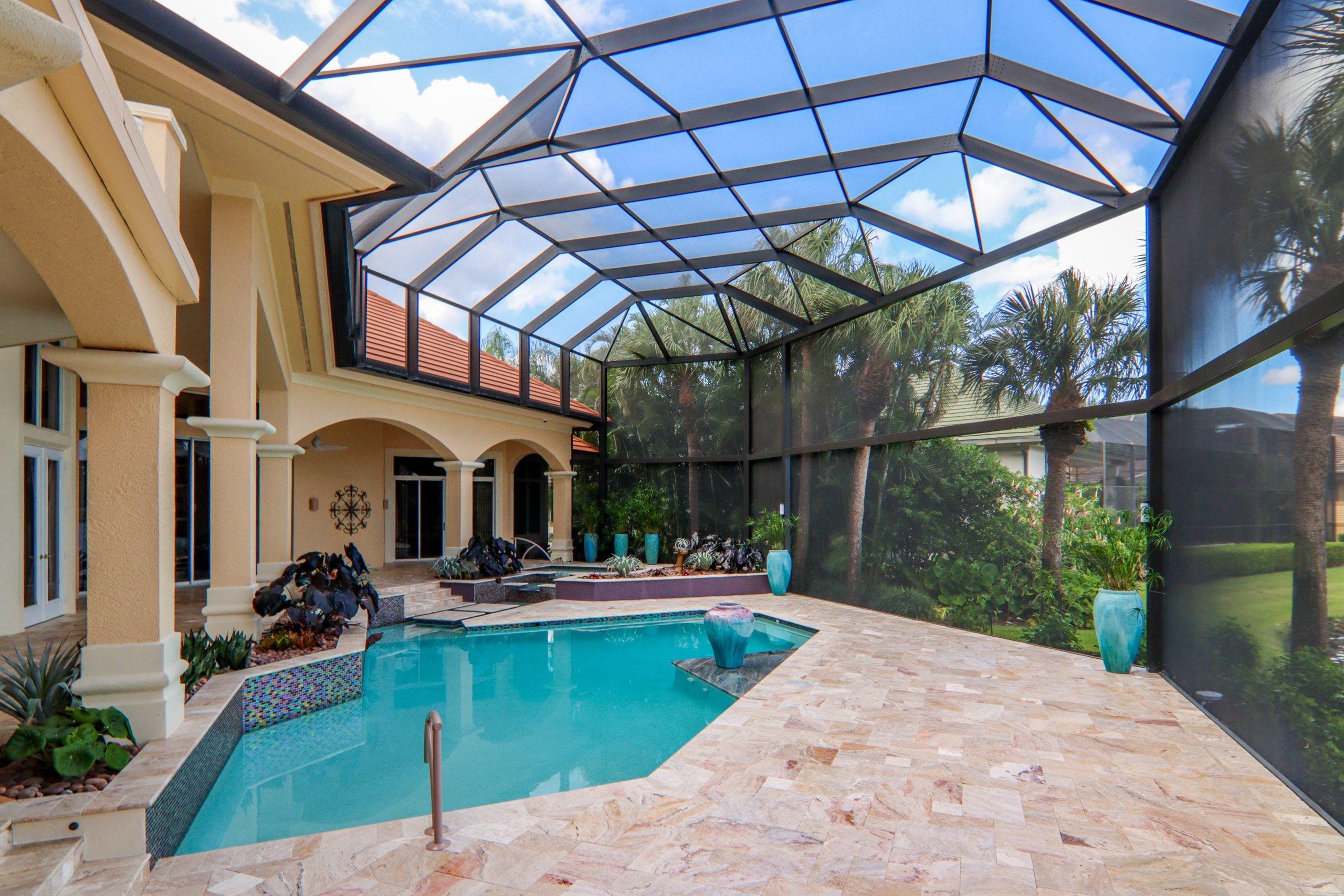
Two provisions matter a great deal in Southwest Florida. A standard screen enclosure that meets the barrier rules may serve as part or all of the barrier, treated as a nondwelling wall (R4501.17.1.11); see pool cages and screen enclosures. And on waterfront lots, a permanent bulkhead, canal, lake or navigable waterway may be accepted as a barrier, but only when the authority having jurisdiction approves it (R4501.17.1.14.1). A pool with an ASTM F1346 safety cover is exempt from the barrier section.
Chapter 45 also requires filtration that turns over the pool's volume in 12 hours or less, a 35 psi pressure test of the piping, steps or a ladder where the shallow end exceeds 24 inches, and ladders, stairs or swim-outs where the deep end exceeds 5 feet. Where a high water table is expected, a hydrostatic relief device is required. Final electrical and barrier inspections must pass before the pool is filled (vinyl-liner and fiberglass pools excepted).
The pool barrier requirements in Section R4501.17 turn the statute into measurable numbers:
- The top of the barrier at least 48 inches above grade, measured on the side away from the pool.
- No more than 2 inches between grade and the bottom of the barrier (4 inches where it is mounted on an above-ground pool structure).
- No opening that would pass a 4-inch sphere. Vertical members no more than 1 3/4 inches apart where horizontal rails are under 45 inches apart (rails on the pool side), or 4 inches apart where the rails are 45 inches or more apart.
- Chain link mesh no larger than 2 1/4 inches square, unless slats reduce the openings to 1 3/4 inches.
- Self-closing gates that open outward, with a self-latching device on the pool side. A release at least 54 inches above the bottom of the gate may sit on either side.
- Removable child barriers (mesh pool fences) at least 20 inches from the water's edge, compliant with ASTM F2286.
- Where the house wall is part of the barrier: a UL 2017 exit alarm (85 dBA at 10 feet) on each door and window with direct access, self-closing and self-latching doors with the latch at least 54 inches above the threshold, or an ASTM F2208 pool alarm.
Pool permits and inspections in Lee and Collier counties
Every new inground pool needs a building permit, supported by a site plan or survey, engineered structural details, a pool plan, hydraulic calculations and the method of barrier protection. Collier County's checklist, for example, asks for setbacks, easements and water bodies on the site plan, total dynamic head calculations, the pump's manufacturer curve, the lighting and deck material, and a Residential Swimming Pool Safety Act form. Lee County's application has the applicant choose the safety feature up front and acknowledge that a permanent enclosure, under its own permit, must be in place before final inspection.
A 2026 state law, CS/CS/HB 803, exempts some single-family work valued under $7,500 from permits. As the City of Naples explains it, electrical, plumbing, mechanical, gas and structural work (pool barriers and fences count as structural) and any work in a flood hazard area still need one. A new pool, and any pool renovation touching the barrier, plumbing or electrical systems, remains permitted work.
Pool construction is licensed under Chapter 489, Florida Statutes, and a commercial pool/spa contractor's scope covers any pool, hot tub or spa, public or private. Lombardo Pools is a state-certified commercial pool/spa contractor (license CPC1460063); see how permitting fits into new pool construction.
Who issues the permit depends on where the lot sits, and it is not always the county:
- Unincorporated Lee County: Lee County Community Development. The Lee County Permit Center notes that projects in Bonita Springs, Cape Coral, Estero, Fort Myers, Fort Myers Beach or Sanibel may need to be permitted by that local government.
- Cape Coral: the city's building division. Since September 1, 2025, new and replacement pool permits need a final survey before final inspection, showing the pool's setbacks, the equipment and how stormwater sheet-flows across the lot; since March 1, 2026, flood zone lots must also show the lowest point of the pool equipment.
- Unincorporated Collier County: Collier County Growth Management Community Development, through its online portal.
- City of Naples: the city's Building Department. A Naples mailing address is not proof of city jurisdiction, so confirm which government covers the parcel.
- Marco Island: the City of Marco Island Building Services Division.
Pool setbacks, impervious surface and coastal rules are local
There is no statewide pool setback. Setbacks come from the zoning code of the city or county, and they vary by zoning district, by lot type and by what is measured: the water's edge, the deck, the equipment pad or the screen enclosure. Community associations often add rules of their own. As an illustration only, a City of Cape Coral plan review guideline (revised 2021) lists R-1 rear setbacks of 20 feet for the house and 10 feet for a pool cage; confirm the current table before relying on it. Collier County also asks for clearances to power lines and, on septic lots, at least 5 feet from the septic system. Start with your survey, the land development code and any recorded covenants, then confirm with the zoning office.
Does a pool count as impervious surface? It depends on the code doing the counting. Collier County's stormwater plan guide for one- and two-family lots lists swimming pools as impervious, along with roofs, concrete, cool deck coatings and pavers on a limerock base, while pavers without a limerock base, crushed stone and grass count as pervious. The impervious share decides which stormwater plan the permit needs. Other jurisdictions define it differently, so ask how your pool and deck will be counted; near a limit, the choice of deck material matters.
On Gulf-front lots, construction seaward of the state Coastal Construction Control Line generally needs a Florida Department of Environmental Protection permit (section 161.053), though a single-family pool that does not advance the line of existing construction may qualify for a general permit. In coastal high-hazard (V) zones, pools must be designed and constructed to ASCE 24 (R322.3.3.1).
Condominium, HOA and public pool regulations
Chapter 514 defines a public pool to include pools serving subdivisions and cooperative living-type projects of five or more living units, such as apartments, hotels and townhouses. A private pool serves only an individual, family or living unit and their guests.
Public pools are built to Section 454 of the Florida Building Code, Building, and operated under Chapter 64E-9, F.A.C., through county health departments. The operating permit application goes to the Department of Health before the building permit application (514.03), the pool cannot open without the department's inspection and permit, and the permit is renewed yearly. Public pools and spas also need an anti-entrapment system meeting ASME/ANSI A112.19.8 or its successor (514.0315).
Florida condominium swimming pool regulations carry size-based exemptions in section 514.0115:
- Pools serving no more than 32 condominium or cooperative units, not operated as public lodging, are exempt from Department of Health supervision except for water quality.
- Pools serving more than 32 such units, where recorded documents bar rentals shorter than 60 days, still need construction plan approval and an initial operating permit, with annual inspections for water quality and lifesaving equipment.
- Pools serving homeowners' associations of no more than 32 units or parcels, not operated as public lodging, are exempt except for water quality and the anti-entrapment rules of 514.0315.
Drain safety (Virginia Graeme Baker Act) and electrical bonding (NEC 680)
The federal Virginia Graeme Baker Pool and Spa Safety Act, enacted in 2007, requires pool and spa drain covers to meet a national anti-entrapment standard; the Consumer Product Safety Commission adopted ANSI/APSP/ICC-16 as the successor standard in 2019, under 16 C.F.R. part 1450. A public pool with a single blockable drain, or multiple drains on the same plane less than three feet apart, also needs a secondary anti-entrapment device or system. For a private pool, Florida's code requires suction outlet entrapment protection under ANSI/APSP/ICC 7 (R4501.6.6).
Electrical work follows Chapter 27 of the Florida Building Code, Building, which applies NFPA 70, the National Electrical Code; its Article 680 covers pools. Equipotential bonding ties the shell's reinforcing steel, the perimeter deck, metal fittings and equipment together to reduce voltage gradients around the water, and Chapter 45 adds ground-fault protection for pump outlets and underwater lights above the low voltage contact limit. Because the bonding runs beneath the deck, shell, coping and deck should be designed together, as in our custom pool design work. For HOA, hotel and community projects, our commercial pool work centers on this code and Department of Health coordination.
Sources
- Florida Statutes, Chapter 515, Residential Swimming Pool Safety Act (2026)
- Florida Statutes, Chapter 514, Public Swimming and Bathing Facilities (2026)
- Florida Statutes, Section 161.053, Coastal construction and excavation
- Florida Statutes, Section 489.105, Contractor definitions
- 2023 Florida Building Code, Residential, 8th Edition, Chapter 45 Private Swimming Pools
- 2026 Florida Building Code, Residential, 9th Edition, Chapter 45 Private Swimming Pools
- 2026 Florida Building Code, Residential, 9th Edition, Chapter 3 (R326.1)
- 2023 Florida Building Code, Residential, 8th Edition, Chapter 3 (R322 flood-resistant construction)
- 2024 International Residential Code, Chapter 3 (R328.1)
- 2023 Florida Building Code, Building, Chapter 4 (Section 454 swimming pools and bathing places)
- 2023 Florida Building Code, Building, Chapter 27 Electrical
- Florida Building Commission, 9th Edition (2026) FBC workplan, October 2026
- Florida Administrative Code, Chapter 64E-9, Public Swimming Pools and Bathing Places
- U.S. Consumer Product Safety Commission, Pool and Spa Drain Covers (business guidance)
- U.S. Consumer Product Safety Commission, Pool and Spa Drain Covers FAQ
- NFPA 70, National Electrical Code
- Lee County Permit Center
- Lee County Pool Permit Application (10/2025)
- City of Cape Coral, Notice to Industry: Final Survey Requirement for Pool/Spa and Generator Permits (amended February 2026)
- City of Cape Coral, Design Standard Guideline, New Construction Residential (revised 2021)
- Collier County Growth Management, Application Requirements: Pools (PRSPL, 1/27/2025)
- Collier County Growth Management, Stormwater Plan Guide (10/15/2025)
- City of Naples Building Department
- City of Naples, Building Permit Exemptions for Residential Properties (HB 803)
- City of Marco Island Building Services
- Florida Department of Environmental Protection, Coastal Construction Control Line Program